
More life — and more everyday mess
Living with a young child and a dog or cat brings plenty of joy — but also more hair, dust, allergens and everyday mess. Where do these particles collect, and what can parents realistically do to manage them?
Dogs and cats are family members. Children play with them, cuddle them and often share the same spaces: the living room, carpet, sofa and sometimes even the bed.
That is completely normal. At the same time, there is a simple reality: the more people and animals use a home, the more everyday material naturally accumulates in it.
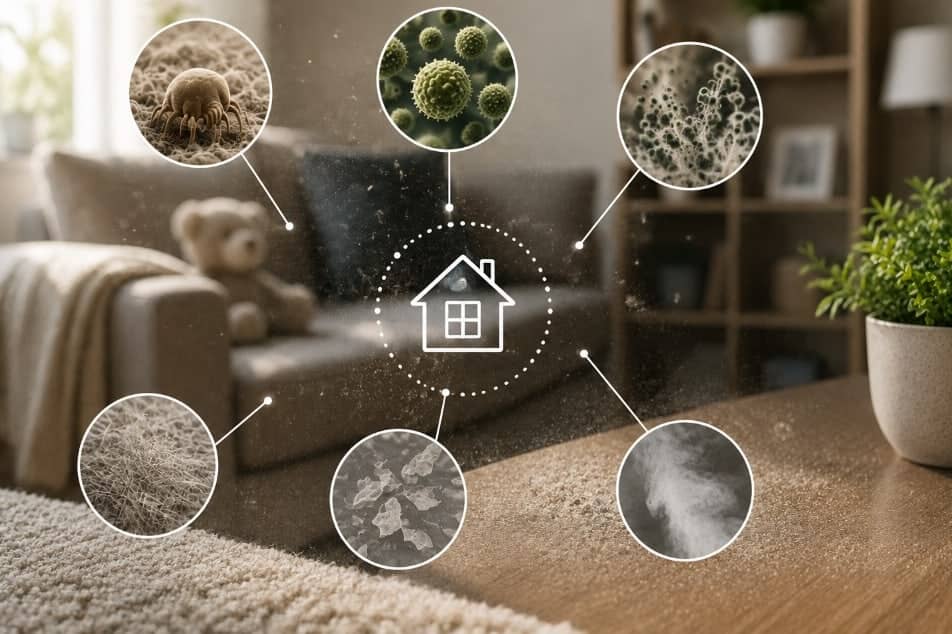
And it is not just pet hair. Animals can bring skin particles, allergens from saliva or urine, and particles from the outdoor environment. These allergens can become part of household dust and settle into carpets, upholstery and other textiles. More: what pets leave behind and allergens at home.
For a young child, this matters because they interact with the home very differently from adults. A child crawls on the floor, sits on carpets, leans against the sofa and spends a lot of time on soft surfaces adults often overlook.
This is not a reason to create a sterile home. It is a reason to know where dirt builds up and how to manage it reasonably.
1. Hair is only part of the story
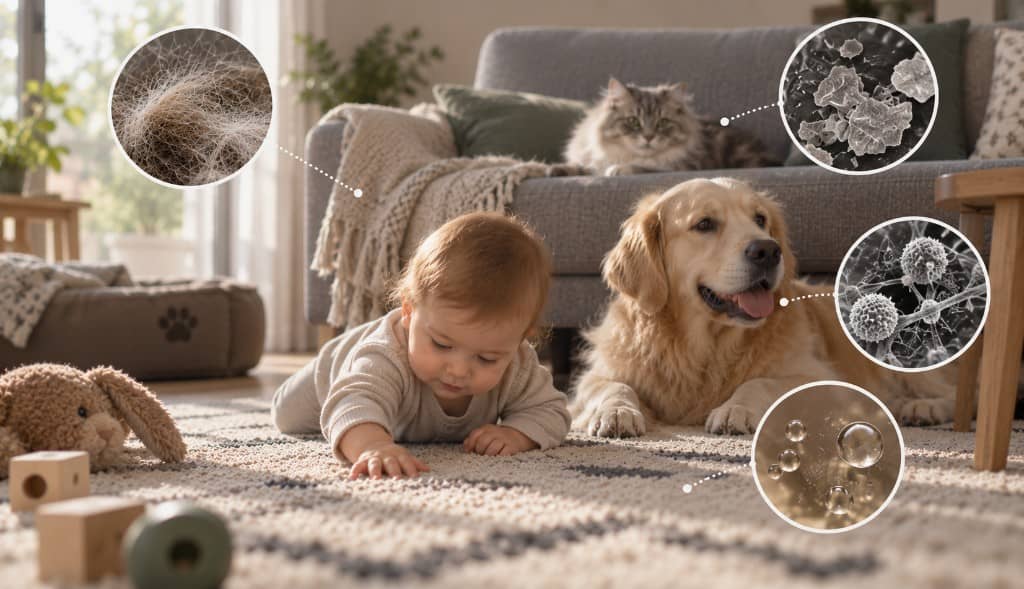
Pet hair is the most visible sign. It can collect in:
- carpets
- sofas
- armchairs
- beds
- blankets
- pet beds
- children's textiles
But pet hair itself is not the main cause of dog or cat allergy. The important allergens are specific proteins.
AAAAI explains that major animal allergens are proteins found in dander, saliva and urine. These allergens can then spread through the indoor environment.
That means: less visible hair does not automatically mean less allergen.
2. Pet allergens can end up where the animal has never been
Your dog or cat does not necessarily have to sleep on the sofa for pet allergens to reach it.
They can spread through household dust and may also be carried on clothing. AAAAI notes that animal allergens can remain in the air, on furniture and on clothing, even reaching areas where the animal itself is not present.
So keeping a pet out of one room does not make that room completely allergen-free.
Why does this matter more with young children?
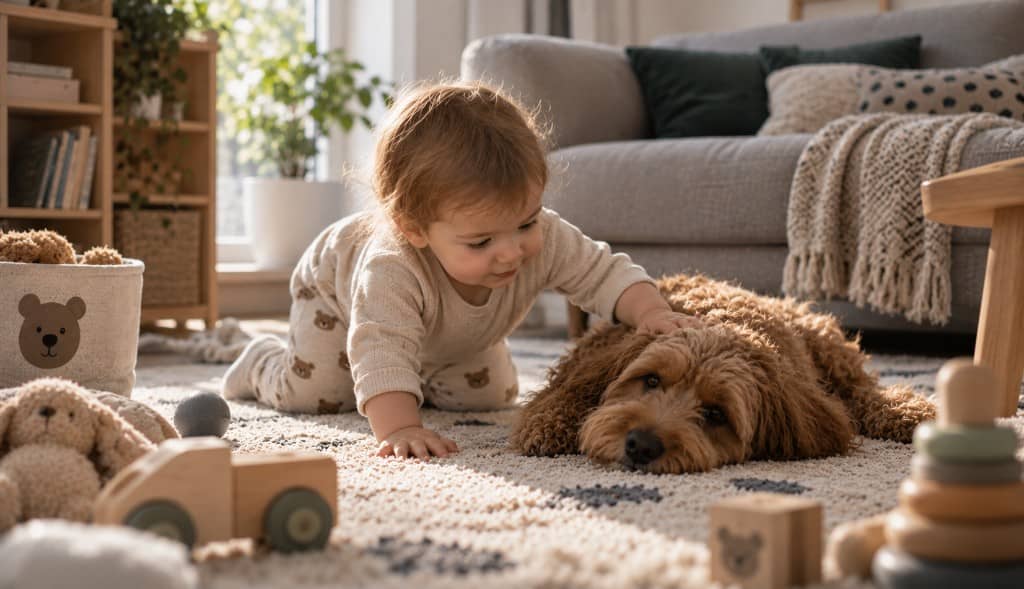
Young children interact with their environment differently from adults.
- They crawl
- They sit on the floor
- They play on carpets
- They lean on furniture
- They cuddle pets
- They spend time on blankets and soft surfaces
This is not a reason to panic. It is a reason to clean where your child actually spends time.
There is little point perfectly cleaning a room a child barely enters while overlooking the carpet, sofa or play area.
The sofa: where children, pets and everyday life meet
In a home with a pet, the sofa can become one of the most heavily used textile surfaces. A child eats there. The dog sleeps there. The cat lies there. Parents relax there.
Over time, the upholstery may collect:
- pet hair
- dust
- crumbs
- skin particles
- body oils
- odours
- other everyday dirt
AAAAI recommends that people with pet allergies keep animals out of bedrooms and, where possible, limit access to upholstered furniture.
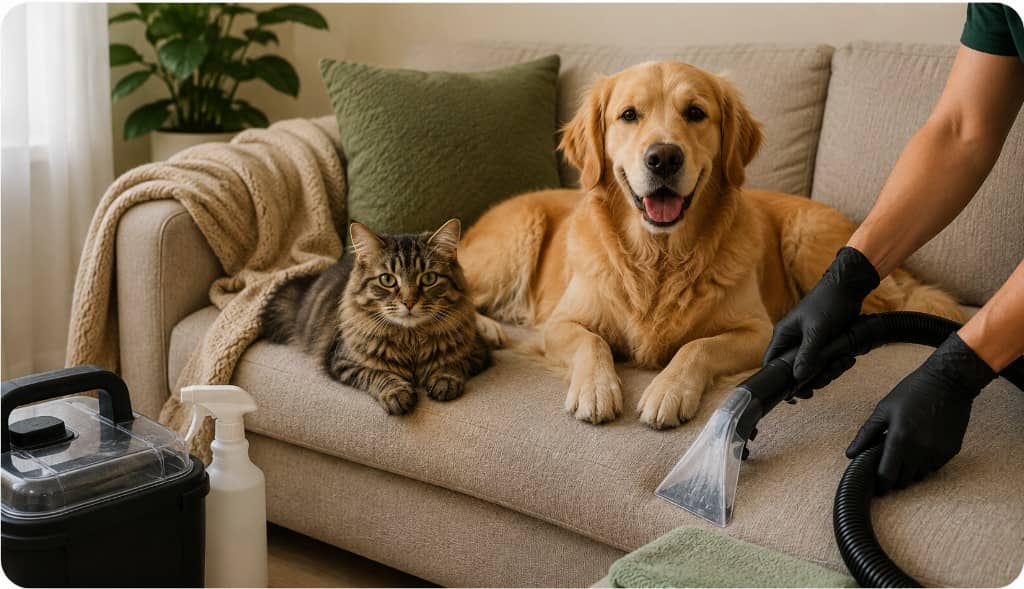
In a real family home, that is not always practical. That makes regular care of heavily used textile surfaces especially important. Tip: how to clean a sofa.
The carpet and the children's play area
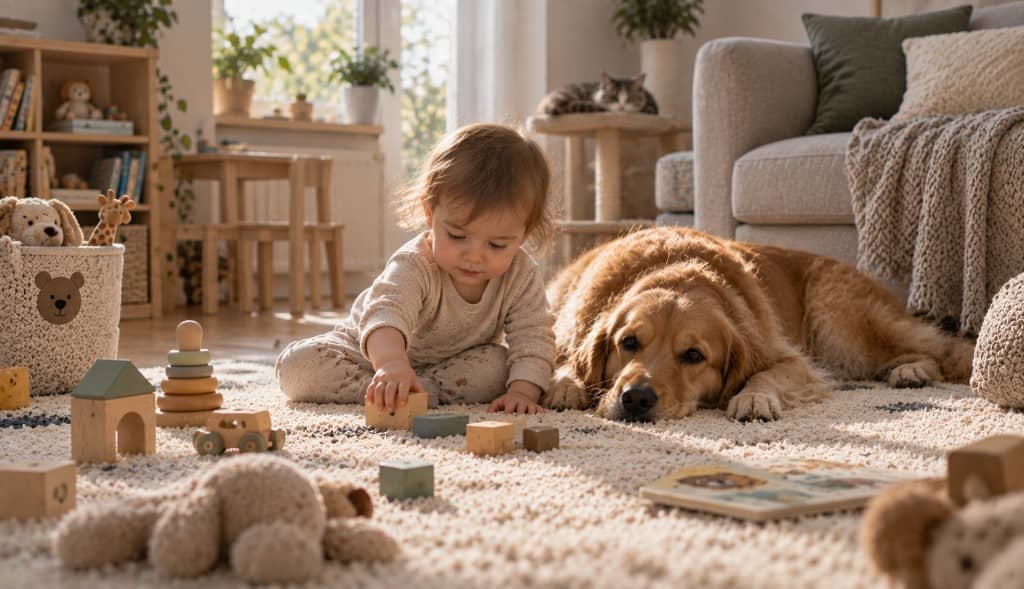
For a young child, a carpet can effectively become an extension of the floor. They sit on it, play on it and crawl across it. Pets may use the same carpet for resting.
AAAAI recommends regular vacuuming of carpets and reducing dust-collecting surfaces where possible for people dealing with indoor allergies.
Do not focus only on the centre of the carpet. Also clean:
- edges
- corners
- underneath furniture
- the children's play area
- around the pet bed
- high-traffic sections
Practical guide: how to clean a carpet.
What about a child's bed?
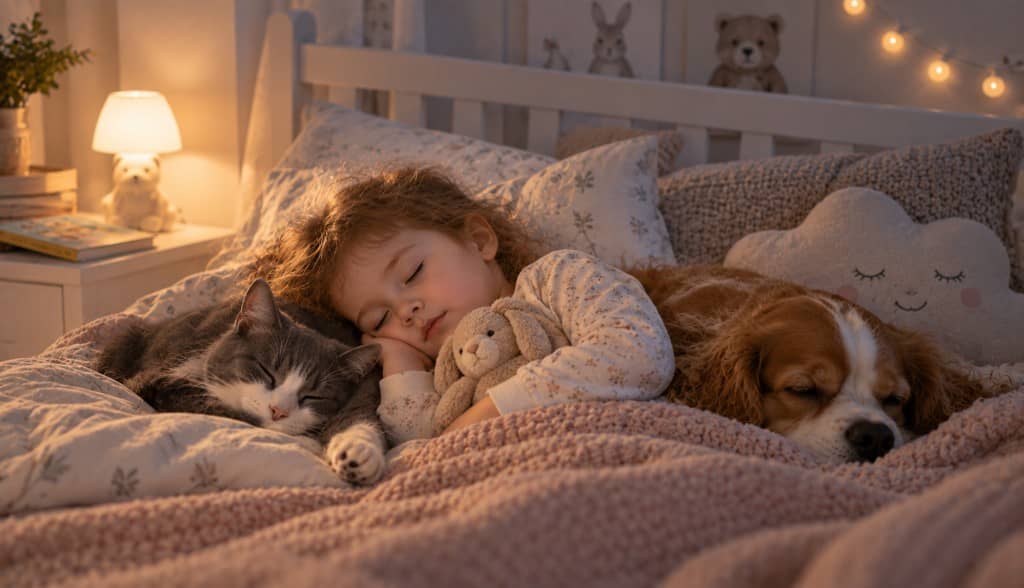
There are two different situations.
If a pet never enters the child's bedroom, managing exposure is easier.
If the child regularly sleeps with the pet or the animal has access to the bed, exposure to animal allergens can be higher.
AAAAI recommends keeping pets out of bedrooms for people who are allergic to animals.
That does not mean every child without a diagnosed allergy needs a completely pet-free bedroom. It is primarily guidance for people who are already sensitive to animal allergens.
More on mattress care: how often to clean a child's mattress.
The most overlooked item? The pet bed
A dog or cat may spend many hours every day in the same bed. So it naturally accumulates:
- hair
- skin particles
- dust
- skin oils
- crumbs
- odours
- outdoor dirt
If the cover can be washed, use that option regularly according to the manufacturer's instructions.
What about large or non-washable pet beds? That is where professional cleaning can become useful.
What does research say about children and indoor allergens?
This is where it is important to be precise. Systematic reviews show that reducing indoor allergen exposure is not a simple “less allergen = less asthma” equation.
A 2025 systematic review included 54 studies of indoor environmental interventions involving children and adolescents with asthma. Results were highly heterogeneous. Some evidence was promising for particular interventions targeting dust mites, while many other interventions did not show clear clinical effects.
Another systematic review evaluated interventions such as HEPA filtration, carpet removal, mattress cleaning, mould removal and other measures. Again, the effectiveness varied depending on the intervention and circumstances.
The practical takeaway: there is no single cleaning method that guarantees prevention of allergies or asthma.
But maintaining a cleaner environment and reducing exposure to a known allergen can form part of an overall management strategy.
Do dogs or cats actually cause childhood asthma?
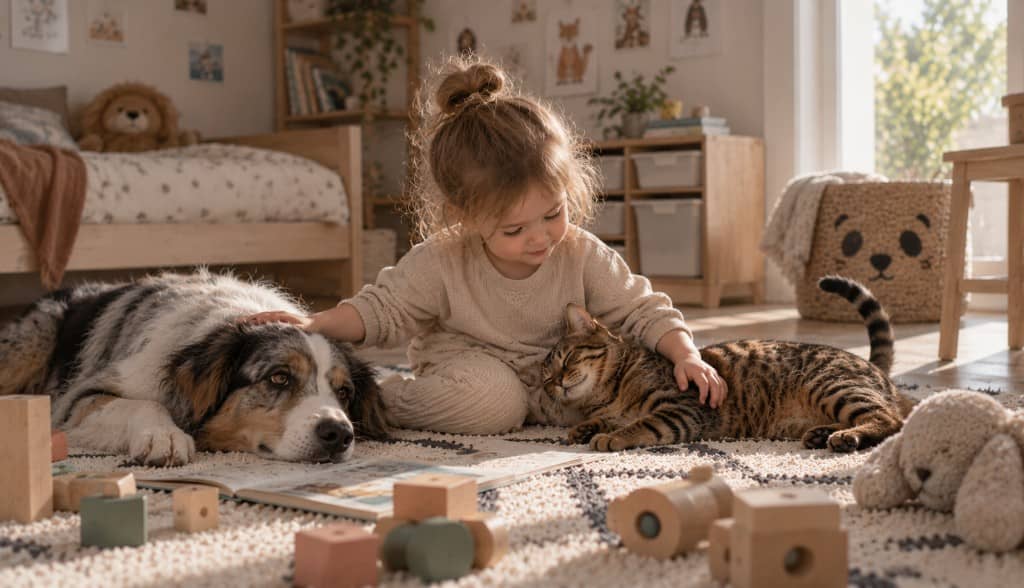
This is an area where internet claims often contradict each other.
A meta-analysis of 60 studies involving more than 1.87 million children found a statistical association between dog or cat ownership and childhood asthma. However, most of the evidence came from observational studies, meaning the results do not prove that owning a pet caused asthma.
So it would be wrong to say: “Having a dog causes asthma in children.” It would also be wrong to claim: “Having a dog protects children against allergies.”
The relationship between pets, allergens, early-life exposure and allergic disease is much more complicated.
What can parents actually control?
Much more than simply deciding whether or not to have a pet. You can control the indoor environment your child lives in.
- Clean floors regularly — especially where your child plays
- Vacuum textiles — carpets, sofas, armchairs and other fabric surfaces
- Wash blankets and covers — especially those used by children or pets
- Clean the pet bed regularly — according to its material and care instructions
- Keep textiles and surfaces dry — persistent dampness creates another indoor problem
WHO recommends preventing long-term dampness and mould growth indoors because damp and mouldy environments are associated with increased respiratory symptoms, allergies and asthma. Tip: humidity in the apartment.
When is normal home cleaning enough?
Often, it is.
If your sofa is regularly vacuumed, not heavily soiled and properly maintained, it does not need professional cleaning every time your dog leaves a few hairs behind. The same applies to carpets.
Everyday maintenance is the foundation. Regular vacuuming, washing textiles and treating fresh stains promptly are the simplest ways to keep your home in good condition.
When does professional cleaning make sense?
It can be useful when:
- the sofa has become visibly dull
- pet hair is deeply embedded in the fabric
- the carpet is visibly soiled
- there are older stains
- the textile has developed persistent odours
- a large pet bed cannot be machine-washed
- the same textile surfaces are used heavily by both a child and a pet every day
Professional cleaning is not a replacement for everyday cleaning. It is a deeper maintenance step for surfaces that a vacuum cleaner or washing machine cannot fully deal with.
What can professional cleaning actually do?
It is important to keep expectations realistic.
Professional cleaning can help remove accumulated dirt, pet hair, stains and some particles trapped in textile fibres.
It cannot honestly be described as a way to remove every allergen or guarantee that a child will not develop an allergy.
Systematic reviews show that the health effects of different household interventions are not universal.
The realistic goal is much simpler: keep textile surfaces clean, remove accumulated dirt regularly and reduce unnecessary exposure to specific allergens where possible.
Do you need to give up your pet?
No.
AAAAI states that having a pet allergy does not automatically mean that the animal must leave the home. Proper diagnosis and an individual management plan with an allergist are more appropriate, together with practical exposure-reduction measures.
For a family, the goal is not to create a pet-free home. The goal is to create a reasonably clean environment where your child can live, play and grow.
A simple cleaning routine for homes with children and pets
You do not need to deep-clean the whole home every day. A realistic routine works much better.
- Every day — quickly remove visible hair and dirt from areas where your child plays
- Several times a week — vacuum floors and carpets, and clean sofas or other pet areas when needed
- Once a week — wash blankets, covers and other regularly used textiles
- Regularly — check the condition of the sofa, carpet, mattress and pet bed
- When needed — arrange deeper professional cleaning when normal maintenance is no longer enough
7 places parents should not forget
If you have a young child and a dog or cat, check these areas regularly:
- Sofa
- Carpet in the children's play area
- Mattress
- Pet bed
- Blankets and throws
- Upholstered chairs and armchairs
- Under furniture and around the pet bed
You do not need to clean all of them equally often. The important thing is knowing which surfaces receive the most daily exposure.
A clean home does not have to be perfect
A young child and a pet bring life into a home — and naturally, they also bring more hair, dust, stains and everyday mess. That is normal.
You do not need to disinfect the entire apartment every day. You do not need to throw away a carpet because your dog walked across it.
A much better approach is to have a simple, consistent routine, focus on the surfaces that receive the most use and remember the textiles that ordinary cleaning often overlooks.
And when a vacuum cleaner is no longer enough, deeper cleaning can help.
Cleanárna provides professional sofa, carpet, mattress, armchair, chair and other textile cleaning in Prague and the surrounding area.
The cleaning method is adapted to the material and its condition.
Have a young child and a pet and not sure what needs a deeper clean?
Send us a photo of your sofa, carpet, mattress or pet bed. We can recommend an appropriate cleaning approach and give you an estimated price. Order.
A cleaner home. Calmer everyday life.
Sources & research
Dust mite facts in this article come from peer-reviewed studies and health organisations — not clickbait claims like “millions of mites in one mattress”.
- AAAAI — Indoor Allergens
- AAAAI — Managing Indoor Allergen Culprits
- WHO — Guidelines for indoor air quality: Dampness and mould
- PubMed — Indoor environmental interventions and childhood asthma (54 studies, 2025)
- PubMed — Effectiveness of indoor allergen reduction in asthma (AHRQ review)
- PubMed — Pet ownership and childhood asthma meta-analysis (60 studies, 1.87M children)
Frequently asked questions
Is pet hair the main cause of dog or cat allergy?
No. AAAAI explains that the main sources are proteins in dander, saliva and urine. Less visible hair does not automatically mean less allergen.
Do you have to give up a pet if there is an allergy?
AAAAI states that a pet allergy does not automatically mean the animal must leave. Diagnosis, an allergist’s plan and reducing exposure — for example keeping pets out of bedrooms and limiting upholstered furniture — matter more.
Where does dirt build up most in a home with a child and a pet?
Most often on the sofa, carpet in the play area, mattress, pet bed, blankets, upholstered chairs, and under furniture around the pet bed.
When is home cleaning enough, and when should you call professionals?
Regular vacuuming, washing and quick stain care are enough for everyday maintenance. Professional cleaning makes sense for a dull sofa, deeply embedded hair, older stains, odours, a non-washable pet bed, or very heavy shared use of textiles.
Do dogs cause or protect against childhood asthma?
A meta-analysis of 60 studies found a statistical association, but observational data do not prove causation. It is equally wrong to claim that a dog protects a child from allergy. The relationship is complex.
Ready for professional cleaning?
Calculate your price online — no obligation, instant estimate.
Get instant price