What are dust mites and why mattresses?
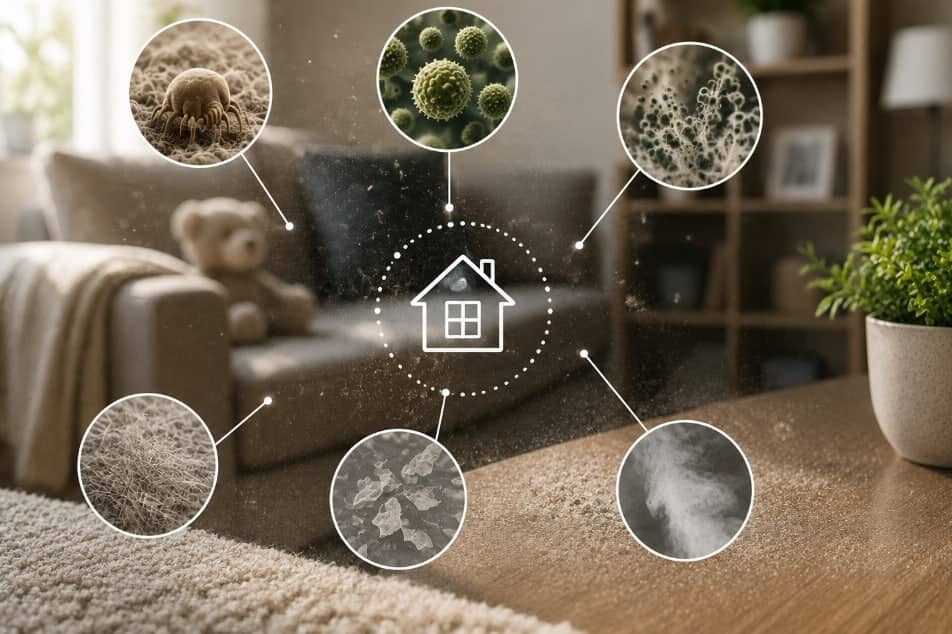
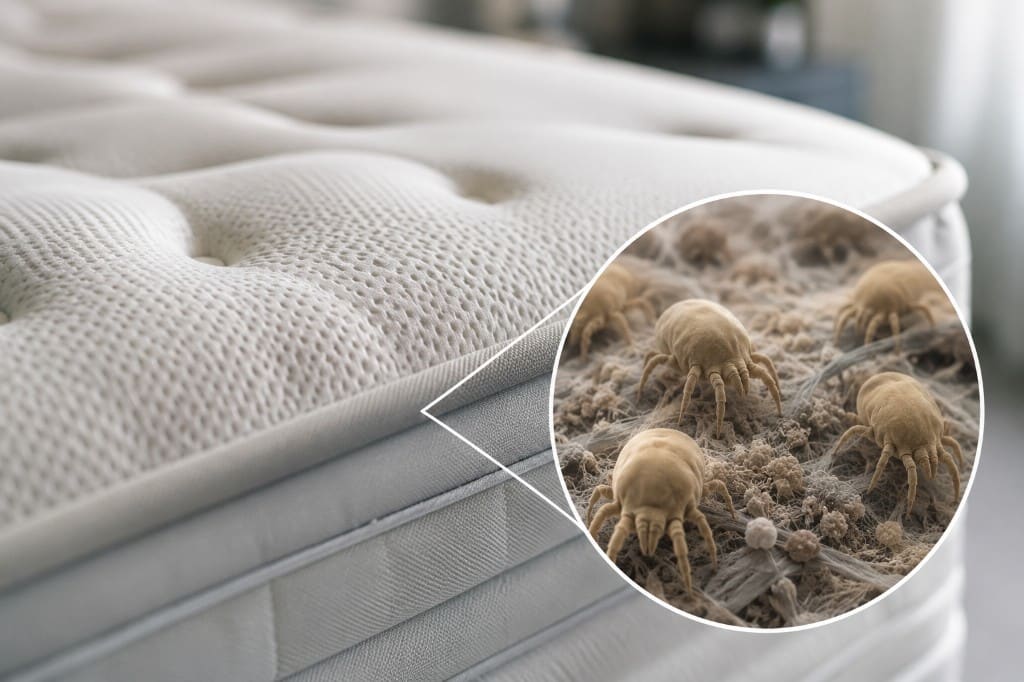
House dust mites are microscopic arthropods you cannot see with the naked eye. They feed mainly on dead skin cells we shed throughout the day.
Mattresses, pillows, carpets and upholstered furniture are places where mites can thrive. Warmth, humidity and plenty of food in dust help them survive. We sleep in close contact with the mattress for hours each night — so it is a significant source of dust mite allergen exposure.
How many dust mites can live in a mattress?
Online claims of “millions of mites in one mattress” are not a universal figure — counts vary widely between mattresses.
Research often reports mites per gram of dust — not as one number for an entire mattress. One study in HDM-allergic patients found a median of 188 mites/g (range 12–1,910); a Spanish survey a geometric mean of about 910 mites/g, with higher counts linked to bedroom humidity and mattress age. Elsewhere, averages of 3,254 mites/g were recorded on the underside of mattresses, with peaks up to 14,500.
There is no single number for every bed. Humidity, temperature, mattress age, dust levels, protectors, airing and cleaning all matter. Dust mites are a normal part of household dust — mattresses are simply a favourable environment.
Are dust mites dangerous?
Mites do not bite or drink blood. The concern is allergens in their droppings, bodies and fragments.
In sensitive people these can trigger or worsen sneezing, runny or blocked noses, irritated eyes, coughing, allergic reactions and asthma symptoms. Dust mites are major indoor allergens — and mattresses can hold high concentrations.
Why do dust mites multiply in a mattress?
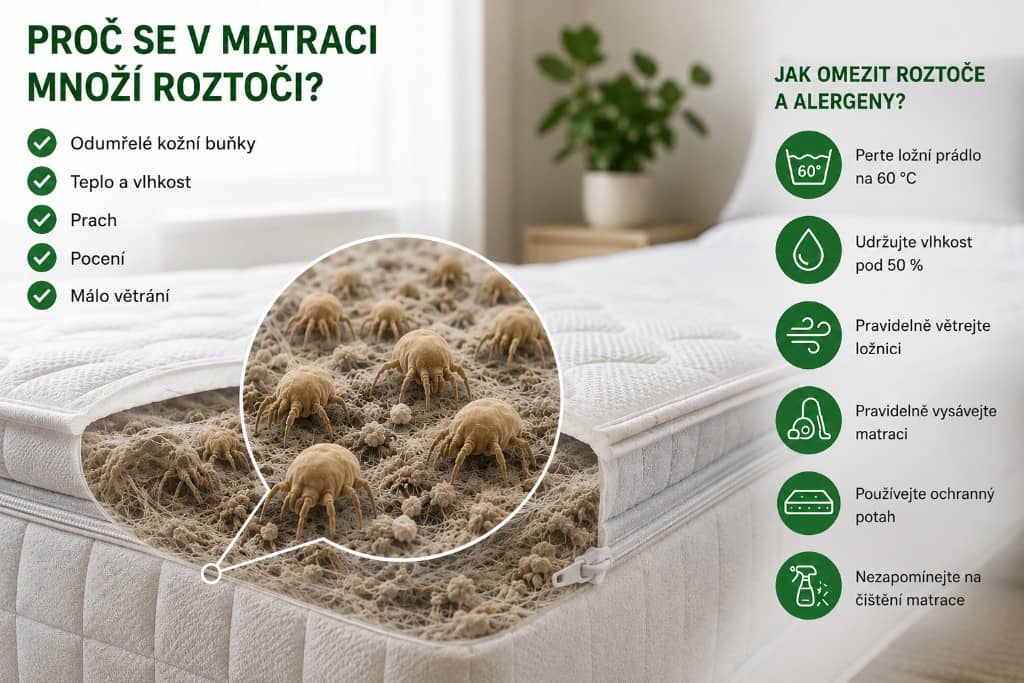
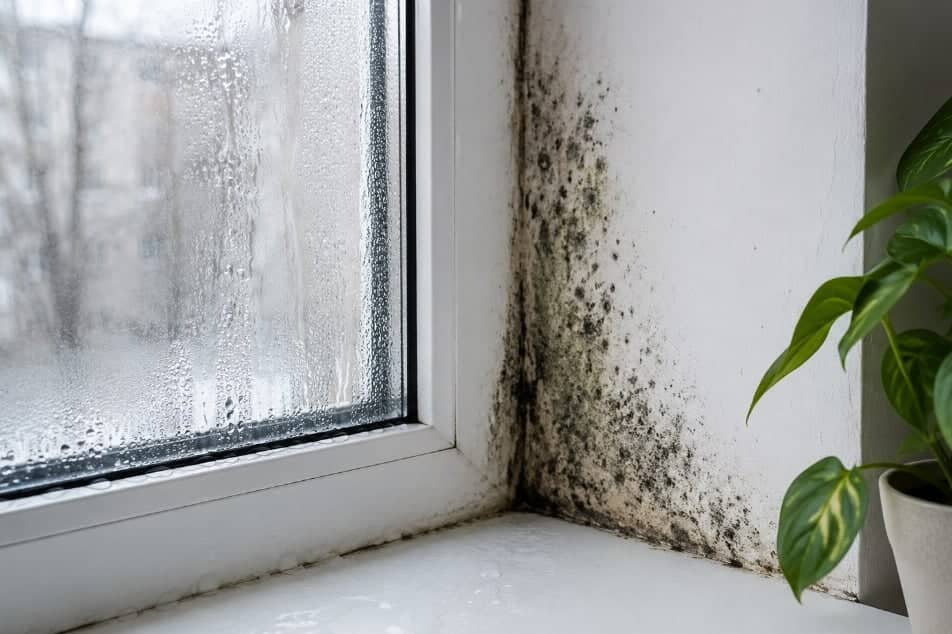
Humidity is key. The American Lung Association recommends keeping indoor relative humidity below 50% to help limit mite growth.
Overnight, a mattress absorbs moisture from your body while skin particles and dust build up inside. Regular airing, washing bedding, humidity control, vacuuming and occasional deep cleaning all help.
How often should you clean a mattress?
Separate routine care from deep cleaning. Wash bedding regularly — around 60°C is often recommended for allergy sufferers when the fabric allows.
There is no universal rule that every mattress must be professionally cleaned every X months. Age, use, sweating, pets, allergies, humidity and stains all matter. As a practical guide, deep cleaning about 1–2 times per year is reasonable, or more when needed — maintenance advice, not a medical standard.
If someone in your home has allergies, you have pets or a small child, or you sweat heavily, more frequent cleaning may make sense.
Is vacuuming enough?
Regular vacuuming helps — a HEPA-filter vacuum is often recommended for sensitive people. Vacuuming alone does not remove all allergens.
Deep mattress cleaning can lift accumulated dirt, dust and stains that normal housekeeping misses. Professional cleaning does not guarantee removal of every mite or allergen — the best results come from combining bedding washes, humidity control, covers and periodic deep care.
How to keep your mattress cleaner longer
Simple habits that reduce dust and allergens in the bedroom:
- Wash bedding regularly — around 60°C when the material allows.
- Keep relative humidity below 50%.
- Air the bedroom often.
- Consider allergen-proof mattress and pillow covers.
- Do not forget the mattress itself — clean sheets do not mean a clean core.
How to protect a mattress from mites and allergens?
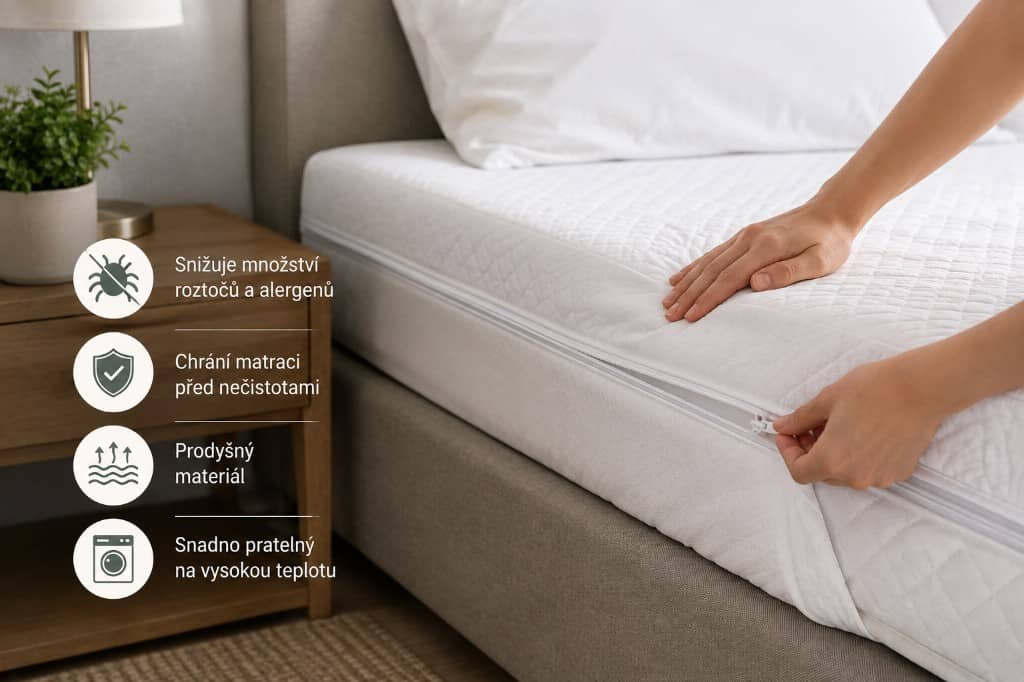
The most reliable barrier is a quality allergen-proof, zip-on cover for the mattress and pillows. It reduces the allergens you breathe at night and keeps dust and stains out of the mattress core.
Look for a breathable fabric that can be washed at a higher temperature (around 60°C when the material allows). A cover is not enough on its own — combine it with airing, humidity below 50% and occasional deep care of the mattress itself.
How does deep mattress cleaning work?
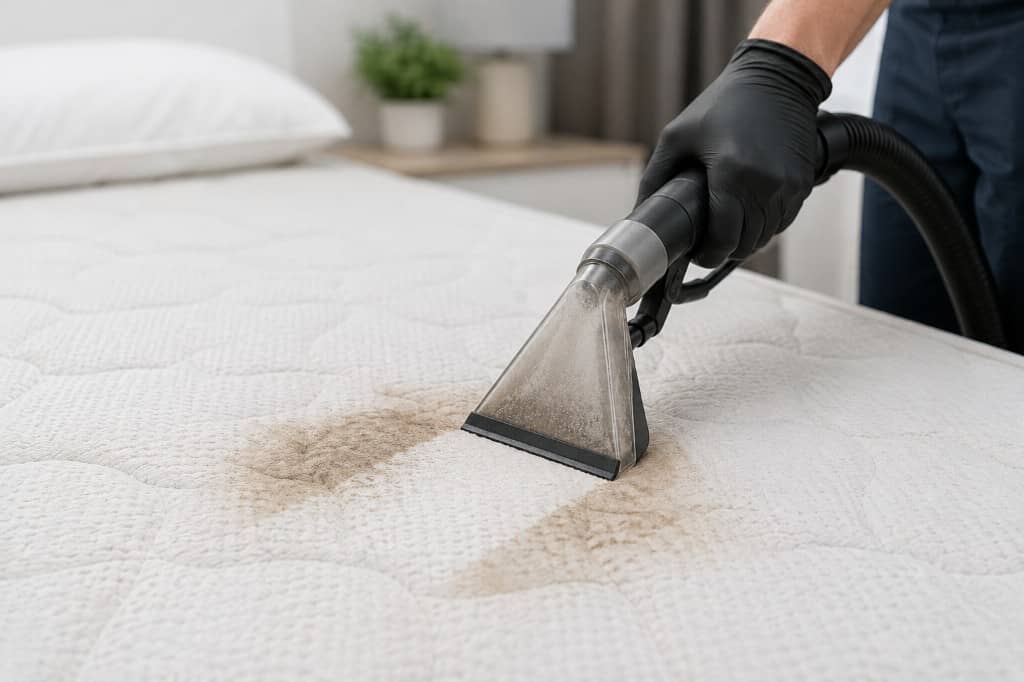
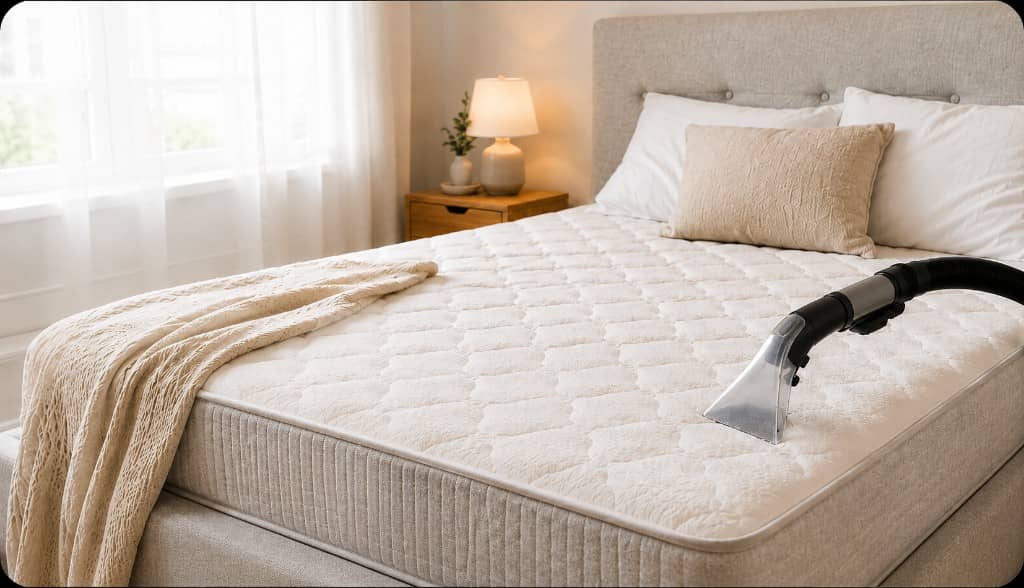
Professional extraction uses water and suction: the nozzle applies a gentle solution and immediately pulls soil out of the textile. The photo shows the contrast — a stain next to a clean path, and dirty water inside the tool head.
This is not ordinary vacuuming. Extraction helps reduce built-up dust, sweat and allergens on the mattress surface. We cannot promise complete removal of every mite — the best result comes with bedding washes and humidity control.
Deep mattress cleaning in Prague
You spend hours on your mattress every night. It deserves the same attention as bedding, carpets or upholstery.
Cleanárna offers professional extraction mattress cleaning in Prague and nearby. We help remove built-up soil and stains that are hard to shift with routine cleaning. See an estimated price in the booking form before you commit.
Sources & research
Dust mite facts in this article come from peer-reviewed studies and health organisations — not clickbait claims like “millions of mites in one mattress”.
- American Lung Association — Dust Mites
- Cambridge University Hospitals (NHS) — Dust mites in your home
- Mayo Clinic — Dust mite allergy
- PubMed — House dust mites and allergens in allergic patients’ homes (median 188/g)
- PubMed — Mite species and allergen levels in Galicia, Spain (~910/g)
- PubMed — Mites on upper vs lower mattress surfaces (up to 3,254/g)
Frequently asked questions
How many dust mites are normal in a mattress?
There is no single universal number. Counts depend on humidity, mattress age, cleaning and protectors. Research cites a wide range of mites per gram of dust — mattresses are a typical hotspot.
How often should I book professional mattress cleaning?
For most homes, deep cleaning about once or twice a year is enough. Allergies, children, pets or heavy sweating may call for shorter intervals.
Is regular vacuuming enough?
Vacuuming is important but does not remove all allergens on its own. Combine it with bedding washes, humidity control and occasional deep cleaning for the best outcome.
Will professional cleaning remove all dust mites?
It significantly improves surface hygiene and reduces built-up soil. We do not promise 100% removal of every mite or allergen — we work with realistic expectations.
Ready for professional cleaning?
Calculate your price online — no obligation, instant estimate.
Get instant price